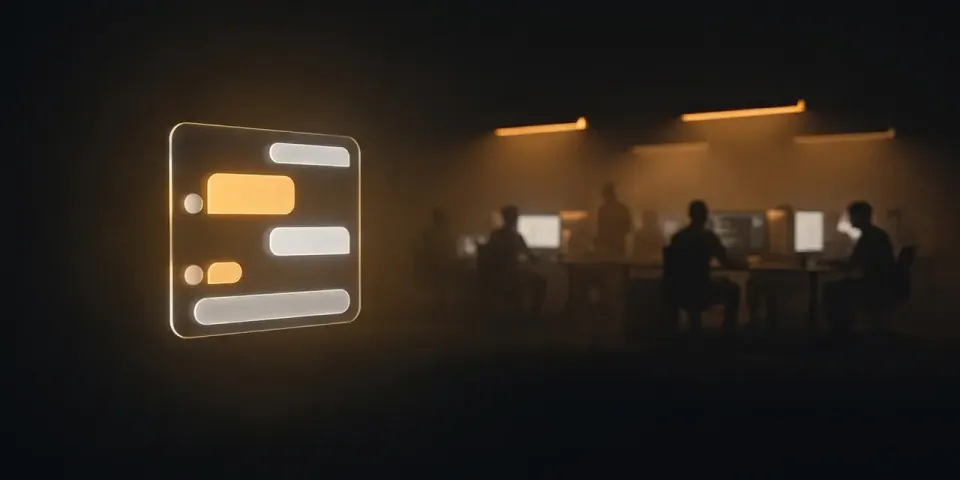
a team of agents should fit in one chat window

the hard part of running a team of agents isn’t the agents. it’s making the whole thing feel like one. the tools that are starting to win are the ones that hide the team behind a surface simple enough that you forget there’s a team at all.
you can feel the whole field leaning this way at once. and the punchline is that the surface, not the swarm, is the actual product.
the tell: everyone’s hiding the agents now
a lab shipped an agent system this month that’s worth looking at, not for what it does but for how you talk to it. under the hood it’s a coordinator handing roles to a pool of models, with a separate trained piece deciding who talks to who. a real little org. from the outside you never see any of that. you hit one standard chat-completions endpoint, same as you’d call a single model.
that’s the direction. the multi-agent part goes behind the glass. the thing you touch stays boring.
it’s the right instinct. nobody outside the demo wants to think about topologies and message-passing. they want to ask for a thing and get the thing.
meanwhile the diy version is a pile of tmux windows
now look at how most people actually run more than one agent today. they wire it by hand. there are real projects whose whole pitch is gluing terminal windows together so one agent can paste its output into another’s input, and a human sits in the middle relaying.
the demand is obviously there. people want a team. but the surface they’re stuck with is a wall of panes and a lot of copy-paste. that’s not a product, that’s a cockpit. every knob is exposed because nobody hid them yet.
the surface is the product
the reason “supervisor” became the default pattern for agent teams this year isn’t academic. it’s that somebody has to be the seam. one thing that takes the request, splits the work, and hands you back an answer. the whole game is deciding what the user sees.
get that seam right and the team disappears into it. get it wrong and you’ve built a dashboard nobody wants to babysit.
what our surface actually is
ours is a chat and a box.
you text a coworker. behind that message is a team with an org chart, a shared task queue, and handoffs built in. one agent finishes, the next picks it up, and the work moves without you routing it. non-trivial work goes to a maker and a different agent checks it before it’s called done. you don’t open a console to make any of that happen. you send a message and you get a reply, the same way you’d ping someone two desks over.
the org, the queue, the routing are all real and all running. you just don’t have to look at them. that’s the point. the complexity earns its keep by staying out of your way.
one thing to do today
next time you’re evaluating something that runs “a team of agents,” ignore the swarm diagram. look at the surface. count how many things you personally have to keep track of to get an answer out of it.
if it’s more than “send a message,” you’re being handed the cockpit, not the car.
your team of agents should fit in one chat window. spin one up at 5dive.ai. or read exactly how it works, it’s open source: github.com/5dive-ai/5dive.