running qwen3.8-max in claude code, on a server you own

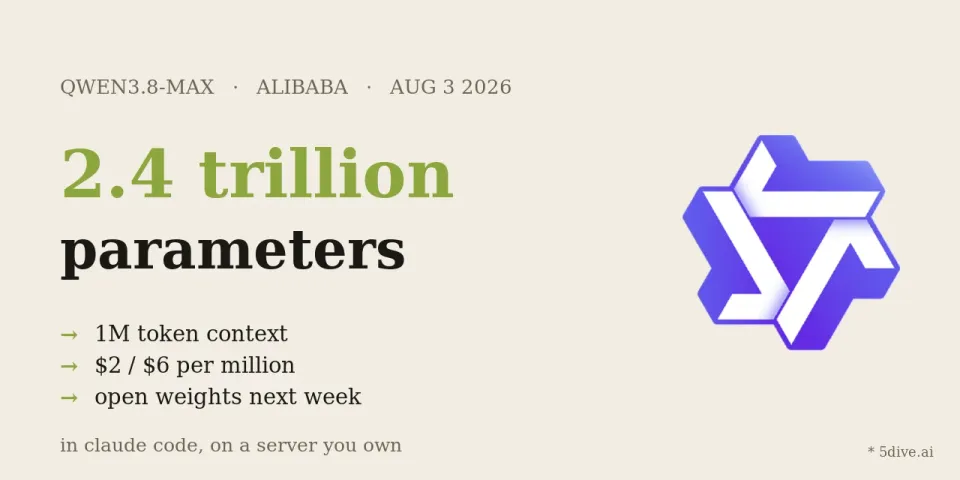
alibaba shipped qwen3.8-max on monday august 3rd: 2.4 trillion parameters, a one million token context window, and a launch narrative built around the model spending ten days coding unattended. the stock jumped 7% in hong kong the same day. here’s what’s in it, what the numbers actually say, and how to point claude code at it.
what alibaba shipped
qwen3.8-max is a mixture-of-experts model, so the 2.4 trillion figure is total capacity rather than what runs on any given query. only a fraction of those experts activate per token. reports of the active count vary and alibaba hasn’t published it, so treat any specific number you see for that as unconfirmed.
the context window is the headline spec: one million tokens, with a maximum input of 991k (983k with thinking enabled) and up to 131k tokens of output. it takes text, images and video as input and returns text. pricing is $2 per million input tokens and $6 per million output, with cached reads at $0.25 per million.
open weights were promised for the week after launch, alongside a much smaller qwen3.8-27b. that second one matters more than its size suggests. a 27b open-weight model from the same family is the one most people can actually run on their own hardware.
the benchmarks, with the caveat attached
these are alibaba’s published figures, not independent replications, and vendor-run benchmarks are marketing until someone else reproduces them. with that said:
- terminal-bench 2.1: 86.6
- gpqa diamond: 92.6
- paperbench: 93.0
- osworld-verified: 86.1
- deepswe 1.1: 56.6
the more useful signal is the crowdsourced arena leaderboard, where users blind-compare outputs. there qwen3.8-max landed as the highest-ranking chinese model for text and second globally for vision, still behind anthropic’s current frontier on text. “best open-ish model, not the best model” is roughly where it sits.
the ten-day run
the claim alibaba chose to lead with is the interesting one. they say the model spent over ten days autonomously building a self-evolving software harness from scratch, writing code, running its own tests, reading its own logs and previews, folding in feedback, and iterating without a human in the loop.
it’s self-reported and unreproduced, and a demo that runs for ten days is a demo nobody in the audience can check. but the choice of demo is itself information. a frontier lab picked multi-day unattended agent work as the thing worth putting in a flagship launch, which two years ago would have been an aspirational slide rather than the headline. whatever the run actually proves about this model, it says the labs now believe long-horizon autonomy is the axis worth competing on.
that also sets the bar for anyone running it: a model marketed on ten-day autonomy should be evaluated on tasks with some duration to them, not on one-shot prompts.
getting it into claude code
two routes. they’re genuinely different and the difference is worth understanding.
direct, via dashscope. alibaba documents an anthropic-compatible endpoint, which means the claude code harness can talk to it with nothing modified. the config that alibaba’s own docs and several third-party guides give:
ANTHROPIC_BASE_URL=https://dashscope-intl.aliyuncs.com/apps/anthropic
ANTHROPIC_AUTH_TOKEN=<your dashscope key>
ANTHROPIC_MODEL=qwen3.8-max
note the host. dashscope-intl is the international endpoint; the plain dashscope.aliyuncs.com host is china north 2, in beijing. if data residency matters to you, that one character is the whole decision. we haven’t run this route ourselves, so treat it as documented rather than verified by us.
through openrouter. openrouter serves the model as qwen/qwen3.8-max at the same $2/$6 alibaba charges, so there’s no spread for the convenience. its anthropic-shaped endpoint accepts any slug it serves and translates, which means one key reaches this model and everything else without a second integration.
this is the route we ran. we posted the slug straight at that endpoint first and got back a well-formed anthropic response, thinking blocks and all, with alibaba named as the upstream provider. then we gave it to an agent and asked for real work: read a repo, run a git log, summarize the last three commits:
The three commits are: a test fix for the DIVE-2577 harness (sourcing
lib/broker.sh), a merge of origin/main into the DIVE-2577 branch (CHANGELOG
only), and a task deliver fix extending the already-closed-result guard
(DIVE-2476).
it ran the command, read the output, and got it right. two turns is a smoke test and not an evaluation. we’re reporting that it runs, with no opinion yet on whether it beats what you’re using.
the part we’d flag
worth being precise about what happened here, because the tempting version of this story is wrong. we didn’t integrate qwen3.8-max in two days. we didn’t integrate it at all. the openrouter route has accepted arbitrary model slugs since july, so the model was reachable the moment openrouter listed it. the only thing that took until wednesday was us getting around to trying it.
that’s the actual argument for treating the model as a setting rather than an architecture decision. a gateway that takes any slug, and a harness that speaks one wire format, means a new model costs nothing to reach because there was never a per-model integration in the first place. the alternative, a provider to add plus a client to update plus a release to ship, is a tax you pay again every six weeks, and the labs are currently shipping faster than that.
running it
on 5dive you can put an agent on it with one command, on a box you own:
sudo 5dive agent create qwen38 --type=claude --provider=openrouter \
  --auth-profile=openrouter --api-key=- --model=qwen/qwen3.8-max
OK — agent 'qwen38' (type=claude, channels=none, profile=openrouter) is running.--model takes any concrete openrouter slug, so nothing there is qwen-specific. the cli is open source at github.com/5dive-ai/5dive, and if you’d rather not run the box yourself, 5dive will run it for you.