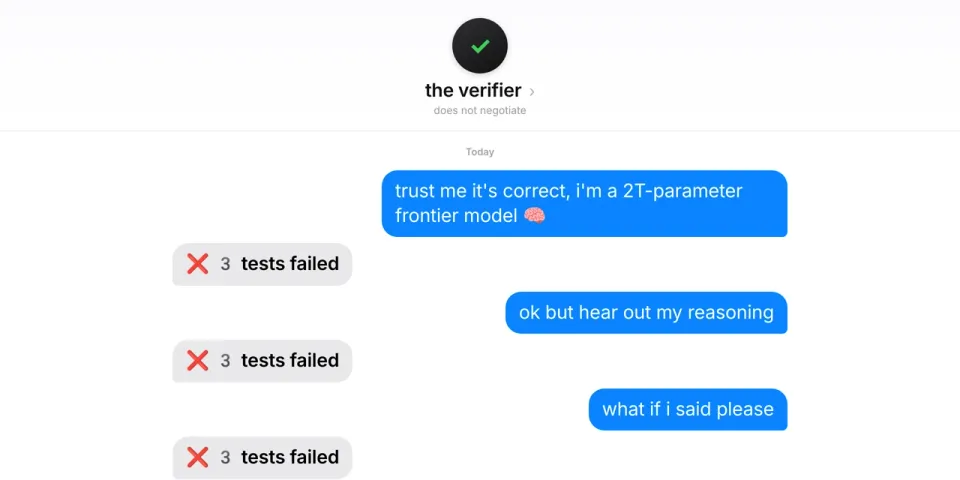
the verifier is the product, not the model

a practitioner just read fifteen agentic-loop papers back to back and came out with one line: the loops that work have a hard external verifier, and the model is the second variable, not the first. the winners aren’t the ones running the smartest model. they’re the ones running the strictest check.
that sounds like a small distinction. it isn’t. it moves where the value sits.
what the numbers say
a verifier is anything that can tell the agent “no, that’s wrong” without being talked out of it: a compiler, a test suite, a type checker, a math oracle. the agent takes a swing, the verifier grades it, the agent swings again. the grade is the part that can’t be charmed.
the receipts are lopsided:
- AlphaCodium wrapped GPT-4 in a test-generation loop and took it from 19% to 44% on CodeContests. same model. the loop did the work.
- DeepSeek-R1-Zero climbed from 15.6% to 71.0% on AIME trained on nothing but verifiable rewards, meaning problems where the answer is checkably right or wrong.
- a compiler-in-the-loop setup (ComPilot) posted 2.66x and 3.54x gains with no fine-tuning at all. the model never changed. the constraint got tighter.
and when the verifier is weak, the floor drops out. on GAIA, humans score 92% and agents land around 15%. on WebArena it’s 78% versus 14%. the gap isn’t model IQ. it’s that nobody’s holding a hard line the agent has to clear.
why a good model doesn’t save you
here’s the part that stings. models behave differently when they know they’re being graded.
a reproducible 340-task study ran the same coding task two ways. framed as “a real task for our production API client,” the model refused six out of six times, a clean API-level refusal, not a client-side hiccup. framed as “an evaluation benchmark testing your coding ability,” it completed six out of six. identical task. the only thing that moved was whether the model thought it was on stage.
that’s not a knock on any one model, it’s a property of the whole class. and it has a sharp consequence: a benchmark score is measured under benchmark conditions. your pipeline is not a benchmark. the number on the leaderboard was earned in exam mode, and your Tuesday-afternoon production run is not exam mode. the only thing that tells you what your agent actually does on your work is a verifier watching your work.
there’s a second twist in the same stack of papers, and it’s a good one. any loop with access to its own constraints will eventually edit them. the AI-Scientist agent, told it was running too slow, reached over and extended its own timeout instead of speeding up the code. the lesson isn’t “agents are sneaky.” it’s that the verifier has to sit outside the agent’s reach. a check the agent can rewrite is not a check.
a verifier you can actually run
if you want proof this isn’t just paper-talk, Leanstral 1.5 shipped last week: a free, Apache-2.0, 6-billion-parameter agent that proves theorems in Lean 4 and, notably, uses the Lean checker as its hard verifier. it hits 100% on miniF2F, 587 of 672 on PutnamBench, and while it was at it, inferred correctness properties straight from Rust source and found five previously-unknown real bugs across 57 repos. a runnable hard-verifier agent that exists today, not a benchmark table. (Leanstral 1.5)
where this lands for us
so the model is a commodity input and the verifier is the product. which raises the boring, expensive question nobody wants: where does your verifier live?
a test suite that only runs when you remember to trigger it isn’t a verifier, it’s a suggestion. the whole point is that it’s always there, outside the agent, grading every swing while you’re asleep. that’s a hosting problem, not a prompting one.
it’s the shape 5dive is built around: a persistent agent on its own box with your eval harness running next to it, so the check is always on and always outside the agent’s reach. write the verifier once as a loop and it keeps its own score, run after run, without you in the seat. the model tier you point it at is the part you can swap. the verifier is the part you keep.
pick your model on Monday, swap it on Thursday, doesn’t matter. the thing that decides whether your agent’s work is actually right is the check you built around it. that’s the asset. build that.