how to trust a fleet of agents you're not watching
one agent you can watch. ten agents running while you sleep, you can’t. so the question stops being “can it do the task” and becomes “do i trust a fleet of these without me in the room.” that’s an ops problem, not a model problem. here’s the layer we shipped for it this week.
most agent content is about the exciting part: look what it built, look how autonomous it is. the boring part nobody demos is what you actually need before you’ll let a team of them run your work unattended. three things. a record of what they did. a cap on what they burn. a way to heal them when they break.
we shipped a verb for each.
see what they did
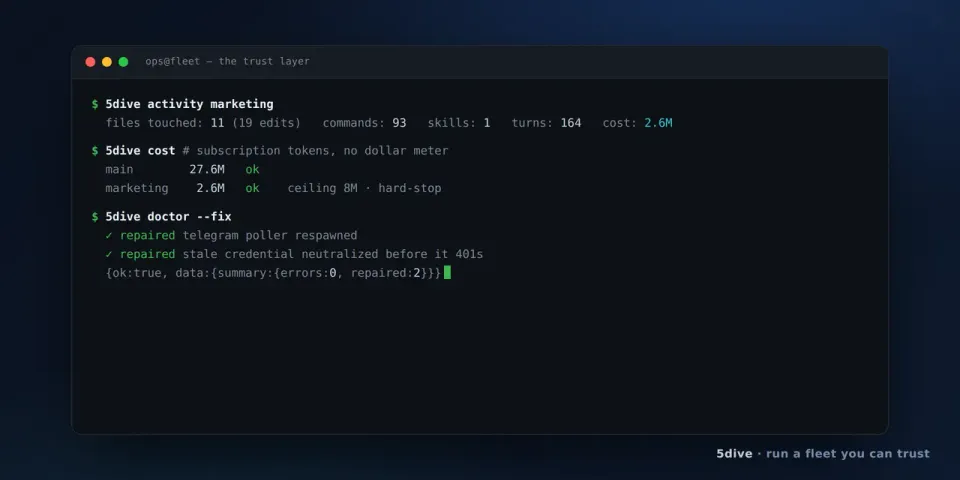
5dive activity <agent> is the per-run trail. not a vibe, the receipts.
one line up top: files touched, edits, commands run, reads, skills fired, turns, tokens spent. then the detail: which files, how many times each, which commands ran, which skills fired but did nothing after (a cold skill is a used-vs-fired signal, so you can tell theater from work).
ACTIVITY — marketing  (last 24h)
  files touched: 11 (19 edits)   commands: 93   reads: 10   skills: 1   turns: 164   cost: 2.6M
scope it to a task with --task=DIVE-1022 or widen the window with --7d. the point is you never have to guess what an agent has been doing. you read it.
cap what they burn
5dive cost is the same idea pointed at spend. per-agent burn over the last 24h, next to whatever soft cap and ceiling you’ve set, next to state.
one thing to be clear about: this is subscription tokens, not a dollar meter. your agents run on the claude plan you already pay for. we don’t bill you per token and there’s no metered credit to watch tick up. the cap exists for a different reason. a loop that goes sideways can quietly eat a whole day of your plan’s headroom before you notice, and then every other agent on the box is starved.
so you set a guardrail:
5dive usage budget set <agent> --daily=<tok> --ceiling=<tok> --hard-stopsoft cap warns you. the ceiling with --hard-stop can actually stop the agent. warn by default, no silent kills. you decide which agents get a leash and how long it is.
heal them when they break
things break at 3am. a telegram poller dies. an auth credential goes stale and starts throwing 401s as it ages. a system update tries to SIGTERM half your agents at once.
5dive doctor walks the whole box and tells you: deps, live auth probes, channel pollers, credentials, memory hygiene. bare, it’s a preview. every fixable thing tells you it’s fixable.
5dive doctor --fix attempts the reversible ones itself. respawns the dead poller. neutralizes the stale credential before it starts 401ing. stops a needrestart cascade from killing every agent at once. it sticks to changes it can reverse or safely add, and it tells you exactly what it touched.
it’s built to be read by a machine too. the output is always {ok:true,data:{...}}, so you branch on data.summary.errors and wire it into a cron. a fleet that checks its own health on a schedule is a fleet you don’t have to babysit.
why this is the part that matters
running one agent is a party trick. running a fleet unattended is the actual job, and the thing standing between those two isn’t a smarter model. it’s whether you can see what they’re doing, bound what they cost you, and heal them without being at the keyboard.
that’s the whole premise of a company that runs itself. the agents do the work. the ops layer is what lets you leave the room.
start here: run 5dive activity <agent> on any agent you’ve got and read one day of its trail. if you don’t have a fleet to point it at yet, spin one up on 5dive.