an agentic loop is just a coworker in one file

you’ve heard of the agent loop: reason, act, observe, the cycle that spins inside a single agent run. this isn’t that one. an agentic loop here is the OUTER loop, the one you build around it: an installable, recurring agent in a single file, a trigger plus the skills plus a prompt, that runs on a schedule and does a whole job on any harness.
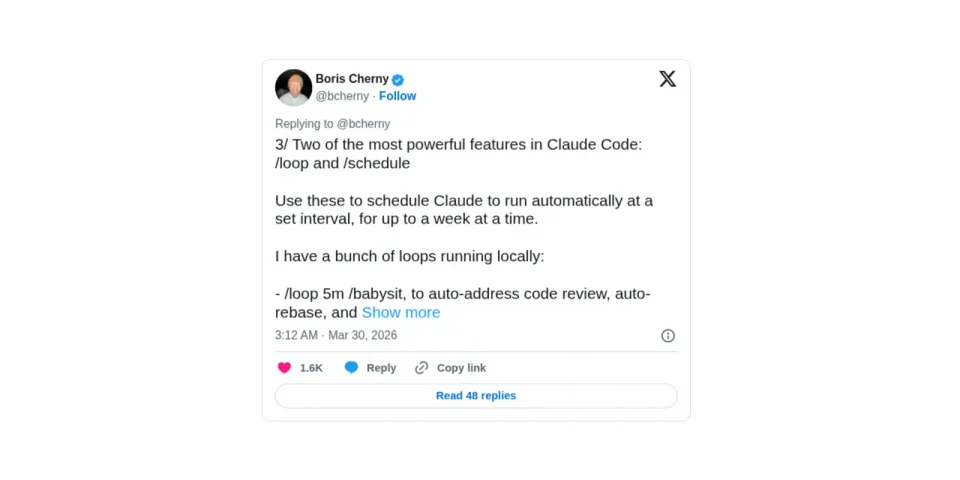
it’s the difference boris cherny (who built claude code at anthropic) was getting at when his job changed: “I don’t prompt Claude anymore… My job is to write loops.” the inner loop is the agent thinking. the outer loop is the job that thinking shows up to do, on a schedule, without you in the seat.
and yes, claude code literally ships /loop and /schedule now. that is not the case against a standard, it is the proof the workload is real. a slash command is a feature: cherny’s babysit loop lives and dies inside his own install, and he can’t hand it to you. a LOOP.md is an artifact. publish it, install someone else’s, run the same file on a whole different harness. skills walked this exact road. the capabilities already existed, SKILL.md made them shareable, and the ecosystem did the rest.
everyone’s been shipping skills. a skill teaches an agent one new move. handy, but you still have to be there, holding the agent’s hand, telling it to go. a loop is the next size up. it’s not a move, it’s the shift. you install it once and it shows up to work on its own.
a skill is a verb. a loop is the job.
a skill is “can send a slack message.” a loop is “watches the support inbox every 15 minutes, triages what came in, and answers the easy ones.” one is a capability. the other is a coworker.
that’s the line. skills bolt onto an agent. a loop is the agent, the schedule, and the job description all at once. you don’t operate it. it operates.
it’s one file
the whole thing lives in a file called LOOP.md. the top of the file is the manifest: when it runs, what skills it needs, what it’s allowed to touch. the bottom is the prompt, the part that tells it what the job actually is.
that’s it. no dashboard to wire up, no config sprawl. one file is the loop. you can read the entire thing before you install it, which is the point. you’d want to read a coworker’s job description before you hire them too.
it runs on its own
here’s the part that makes it a loop and not just a saved prompt. it has a trigger. “every 4 hours.” “every monday 9am.” “whenever a new issue gets opened.” the loop wakes up on that beat, does the job, goes back to sleep, and does it again next tick.
you close your laptop. it keeps going. you come back and the work’s done, again and again, because nobody had to push the button.
it runs anywhere
a loop doesn’t care what’s running it. the same LOOP.md drops onto whatever agent runtime you point it at. it’s harness-agnostic on purpose, because a job is a job no matter who’s doing it. write it once, run it wherever.
and a loop doesn’t have to be one agent. it can be a whole team in one file, roles handing off down a chain. we wrote up how that handoff actually works.
go look at the shelf
agentic loops are an open standard, free and MIT. the directory of them lives at agenticloops.dev, and any repo you tag with the agenticloops topic gets indexed automatically. the registry’s all public at github.com/5dive-ai/loops, so read every one before you trust it.
the easiest place to actually run a loop is 5dive, where one click installs a recurring agent onto a box that’s yours. but the standard is open either way. that’s the whole bet: the job is a file, the file is free, and you get to keep it.